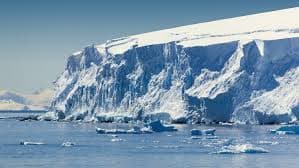
Why in News ?
Recent Scientific Concern
Recent field studies and satellite data show rapid thinning, retreat of the grounding line, and ice-shelf fracturing. This has raised concerns about irreversible instability and Antarctica’s role in future global sea-level rise.
Relevance
GS 1 (Geography) — Core
- Glaciers, cryosphere, sea-level rise
- Physical geography of Antarctica
- Climate–ocean interactions
GS 3 (Environment) — Core
- Climate change impacts
- Global warming and sea-level rise
- Coastal vulnerability and disaster risk
Basics & Core Keywords
What is a Glacier ?
A glacier is a long-lasting mass of compressed snow and ice that flows under gravity. It acts as a freshwater store and climate indicator, sensitive to temperature, snowfall, and ocean conditions.
What is Thwaites Glacier ?
Thwaites Glacier is a large outlet glacier in West Antarctica draining into the Amundsen Sea. It is comparable in size to a large country and is crucial for global sea-level regulation.
Why “Doomsday Glacier” ?
It is called the “Doomsday Glacier” because its collapse could cause major sea-level rise and destabilise nearby ice basins, increasing global coastal risks.
Physical Geography & Glaciology
Marine Ice Sheet Setting
Thwaites sits on bedrock that slopes downward inland below sea level. This marine ice-sheet configuration makes retreat self-reinforcing once warm water reaches the grounding zone.
Grounding Line
The grounding line marks where ice lifts from bedrock and begins floating. Its inland retreat signals weakening stability and higher vulnerability to ocean melting.
Ice Shelf Buttressing
The floating ice shelf slows inland ice flow. Thinning or collapse reduces resistance, allowing faster ice discharge into the ocean.
Climate & Ocean Interactions
Ocean-Driven Melting
Warm Circumpolar Deep Water flows beneath the ice shelf, melting it from below and accelerating grounding-line retreat.
Atmospheric Warming
Rising air temperatures affect surface melt, but ocean heat currently plays the dominant role in destabilisation.
Data & Evidence
Current Contribution
Thwaites contributes about 4% of current global sea-level rise, making it one of the largest individual contributors.
Potential Sea-Level Rise
Complete collapse over centuries could raise global sea levels by around 0.5 metre and destabilise nearby ice, adding several more metres over longer periods.
Observed Changes
Satellite data show rapid thinning, faster ice flow, and grounding-line retreat, indicating ongoing imbalance.
Global Implications
Coastal Vulnerability
Even small sea-level rise increases flooding, erosion, salinity, and storm damage, threatening coastal cities and deltas.
Small Island States
Low-lying islands face displacement, higher adaptation costs, and freshwater loss due to saltwater intrusion.
Economic Impact
Sea-level rise increases costs for infrastructure, insurance, disaster management, and adaptation.
Governance & Policy Dimension
Climate Mitigation Link
Thwaites’ future depends on global warming pathways, making strong emissions cuts under the Paris Agreement essential.
Scientific Cooperation
International Antarctic research improves monitoring, modelling, and early-warning systems.
Challenges & Uncertainties
Timescale Uncertainty
Exact collapse timelines are unclear, but risk-based planning supports early action.
Complex Ice Dynamics
Ice–ocean interactions and feedbacks make modelling difficult, requiring continuous observation.
Way Forward
Rapid Emission Reductions
Keeping warming well below 2°C lowers long-term risks.
Coastal Adaptation
Strengthen zoning, resilient infrastructure, mangroves, and managed retreat.
Polar Research Investment
Expand satellite monitoring, ocean sensors, and radar systems.
Value Addition
- Antarctica stores about 70% of the world’s freshwater
- Antarctic ice could raise sea levels by about 58 metres if fully melted
- Global sea level has risen about 20 cm since 1900
- Current rise rate is around 3.3 mm per year
- Mumbai, Kolkata, and Chennai are among the top 20 global cities at flood risk by 2050
- India has a 7,500 km coastline, making it highly vulnerable